Project Brief
Most manager training on psychological safety fails at the same point: it teaches the concept without teaching the moment. Managers can define psychological safety after a training. What they struggle to do is recognize the specific seconds where they either build it or erode it, and respond differently when it counts.
The real gap is not knowledge. It is behavioral fluency. A manager who aces a knowledge check can still respond defensively when a team member flags a risk in a post-mortem. The gap lives in the space between knowing what to do and knowing what to do right now, when it costs something.
“A team that doesn’t feel safe won’t warn you. They’ll just watch it happen – and assume you didn’t want to know.”
This module closes that gap not through content delivery, but through decision pressure. Learners don’t read about psychological safety. They experience what it feels like to build it or miss it, one choice at a time.
DESIGN APPROACH
The module follows a single fictional manager, Jordan, through one high-stakes week at Vantage Co. after a missed product deadline. A team member, Priya, discloses that she flagged the risk weeks earlier but did not feel safe to escalate it. The learner plays Jordan across three critical moments: an immediate public response, a one-on-one follow-up conversation, and a company-wide all-hands, each of which compounds the previous one.
The branching logic uses a cumulative variable (Safety_Score, range 0–6) rather than discrete right/wrong paths. This was a deliberate structural choice: psychological safety is not built or destroyed in a single interaction. It accumulates across small moments. A module that resets between scenes cannot teach that. One that carries a hidden score forward, shaping the ending without interrupting the narrative can.
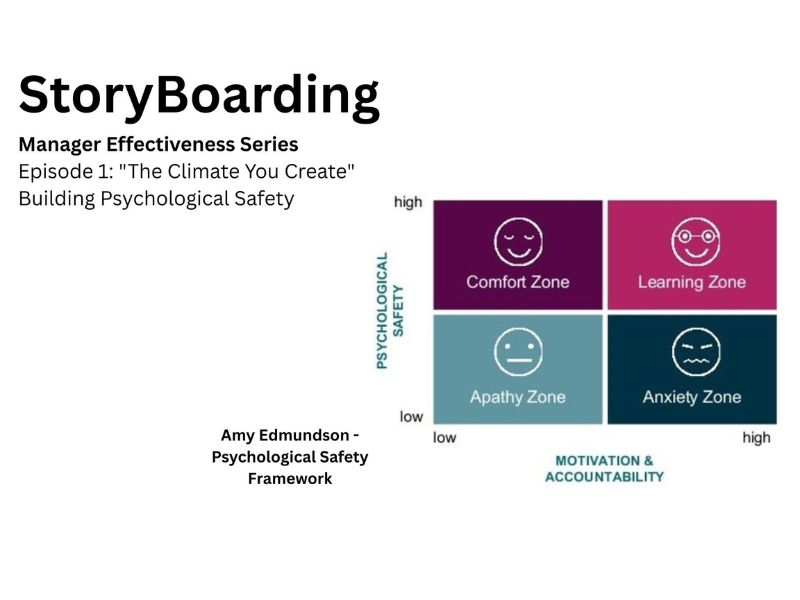
Amy Edmondson’s four-stage framework is introduced through Jordan’s internal monologue after the first branch, framed as the manager “figuring it out”, not as a content delivery slide. This keeps learners in narrative mode throughout and avoids the cognitive break of a lecture insert mid-scenario.
KEY DESIGN DECISIONS
| The framework lives in reflection, not a slide. | The most dangerous option isn’t the obvious wrong answer. | The ending is earned, not explained. | Completion, not score, drives the SCORM trigger. | The Leadership Snapshot avoids score-as-judgment. |
| Introducing Edmondson’s model through Jordan’s internal monologue, rather than a content screen, keeps the scenario unbroken and the learner emotionally invested. The theory lands because the learner has just experienced the gap it describes. | In Scene 4, the intuitively generous choice, “You have my word, come to me first, always”, is the lowest-scoring response. It creates manager dependency rather than team-wide safety culture. This mirrors a real pattern in well-intentioned managers. The feedback layer surfaces this without shaming. | Both endings play as a flash-forward to the next sprint, same room, same team, different energy. The contrast is carried by body language and narration tone, not a results screen. Learners infer the consequences rather than being told it, which makes the emotional weight land harder. | This is a behavioral practice environment, not a knowledge assessment. SCORM completion is set to Passed/Incomplete, not Passed/Failed, keeping the tone developmental rather than evaluative. | The outro surfaces the learner’s three choices as a behavioral pattern, not a number. The framing is reflective consistent with how adults process feedback about their own interpersonal behavior. |
REFLECTIONS AND LESSONS LEARNED
- Narrative investment requires character specificity. Vague characters produce vague stakes. Jordan and Priya needed readable body language cues and distinct professional contexts for learners to feel the weight of the choices. Instructional designers are also character writers.
- Branching architecture is a content problem before it’s a Storyline problem. Mapping the Safety_Score variable and convergence points on paper before opening the authoring tool saved significant rework. The logic only works if the narrative supports accumulation, which required thinking through story beats first.
- The best distractors mirror real manager behavior. The most instructionally valuable options are not wrong answers — they are what managers actually do when they mean well but miss the mark. Designing those required genuine empathy for the learner, not just content analysis.
- Less consequence narration, more consequence showing. Early drafts over-explained branch outcomes. The final design leans on visual storytelling, team body language, room energy, Priya’s posture, and trusts the learner to read it. That restraint makes the emotional impact stronger.
Scene 01 Cold Open – The Moment LINEAR / NO INTERACTION
| VISUAL | AUDIO / NARRATION / NOTES |
| SLIDE 1.1 – ESTABLISHING Wide shot: Vantage Co. conference room. 8-person table, modern but slightly sterile. Jordan stands at the front. Team seated, a mix of mild discomfort and distraction visible in body language. A slide on the screen reads: “Q3 Post-Mortem.” Clock on wall: 10:04am. | Narrator (VO): “Every team has a climate. Not the kind you can measure with a thermostat. The kind that determines whether people speak up, or stay quiet.” On-screen text: Vantage Co. Post-Mortem Review Soft ambient fade in. No dramatic music, understated. |
| SLIDE 1.2 – PRIYA SPEAKS Medium shot on Priya. She hesitates, glances at her notes, then looks up. Slight tension in her expression, this is costing her something to say. Priya is a mid-level engineer. She looks competent but uncertain in this moment. | Priya (dialogue): “I know this isn’t easy to hear, but… I flagged the API risk in week two. I didn’t feel like it went anywhere, so I just, kept going.” Brief silence. Room shifts. Someone straightens up.SL NOTE: Use character animation with slight pause before Priya speaks. This beat of hesitation is important, don’t rush it. 1.5s ambient pause before her line. |
| SLIDE 1.3 – JORDAN’S BEAT Close-up on Jordan’s face. A flicker of something, defensiveness? Surprise? The reaction is ambiguous. The team watches Jordan. Hold on Jordan’s face for 2 full seconds before transition. | No narration. Room silent. On-screen text fades in: “What Jordan does next will shape what this team is willing to say, for months.” Learner prompt: “You are Jordan. How do you respond?” Transition to Scene 2 (Branch Point 1).SL NOTE: This slide uses a trigger, text fades in with a 2s delay after slide loads. Advance button labeled “Take Jordan’s Seat →” rather than default “Next.” |
Scene 02 Branch Point 1 — The Immediate Response BRANCH POINT · 3 OPTIONS · VARIABLE SET
| VISUAL | AUDIO / NARRATION / NOTES |
| SLIDE 2.1 – CHOICE PRESENTED Same conference room. Jordan is in frame, standing. Three dialogue options appear as clickable response cards below Jordan’s image. Clean layout, no radio buttons, styled as “speech bubbles” the learner selects. Options styled differently, visual weight communicates nothing about which is “right.” All three look equally plausible. | Learner selects Jordan’s response. No narration during selection. Option A: “Why didn’t you escalate it properly? There’s a process for that.” → Defensive. Jumps to process before acknowledging Priya. Sets variable: Safety_Score = 0 Option B”: Okay, let’s make sure we capture that in our learnings doc. Now, solutions: what can we do differently next sprint?” → Dismissive (well-intentioned). Moves on too fast. Sets variable: Safety_Score = 1 Option C” Priya, thank you. That takes guts to say in this room. I want to hear more about what made it hard to raise, can we talk after?” → Open + accountable. Sets variable: Safety_Score = 2 SL NOTE: Set variable “BP1_Choice” = A/B/C. Variable “Safety_Score” accumulates across all 3 branch points (max 6). Affects ending trigger at Scene 7. |
| SLIDE 2.2 A / SLIDE 2.2 B / SLIDE 2.2C – CONSEQUENCE SCENES Short consequence beat for each path. Same room, ~5 seconds. Body language tells the story: team shrinks slightly (A), team goes neutral / Priya nods but deflates slightly (B), team visibly exhales / Priya’s posture opens (C). Consequence plays before merging back to Scene 3. | Path A consequence VO: “Jordan answered the process question. But Priya heard something else entirely.” Path B consequence VO: “A missed moment. Not malicious, just fast. Priya files it away.” Path C consequence VO: “Three words: ‘that takes guts.’ The team felt it too.” All paths merge at Scene 3. SL NOTE: All three consequence slides use identical slide layout, swap character states only. Reuse base Storyline layer, trigger character swaps via state changes. |
Scene 03 Reflection Interlude – Jordan’s Internal Model REFLECTION / FRAMEWORK INTRO
| VISUAL | AUDIO / NARRATION / NOTES |
| SLIDE 4.1 – SCENE SET Small breakout room or hallway. Just Jordan and Priya. More intimate framing, camera closer. Priya has her laptop bag, as if she caught Jordan after the meeting. Body language: cautious but open. Warmer lighting than the conference room. This should feel like a different kind of conversation is possible here. | Narrator (VO): “Jordan gets a second moment. These moments don’t announce themselves – but they’re where trust is actually built.” No music. Ambient quiet. SL NOTE: Scene 4 only triggers if learner selected Option B or C in Scene 2. If Option A was selected, a brief “Jordan reconsidered” bridge slide plays first, a short piece of narration that gives Jordan a reason to seek Priya out. This keeps the learning accessible without rewarding the poor choice. |
| SLIDE 4.2 – EXCHANGE 1 Conversation sim layout. Jordan speaks first. Two-panel format: Priya on left, Jordan’s response options on right. First exchange sets tone. | Jordan opens: “Hey, what you said in there mattered. I want to understand what made it hard to bring this up earlier.” Priya responds: “Honestly? I wasn’t sure it would land. The last time I raised a concern in a sprint review it kind of got… minimized.” Learner selects Jordan’s follow-up: Option A: “That shouldn’t have happened. Who minimized it?” → Defensively problem-solves. Pulls focus away from Priya. Safety_Score +0 Option B: “I hear you. I don’t want you to feel that way on this team. What would help?” → Empathetic but slightly performance-y. Moves to solutions too fast. Safety_Score +1 Option C: “That’s on me to fix. Can you tell me more about what that experience was like?” → Takes ownership + stays curious. Safety_Score +2 |
| SLIDE 4.3 – EXCHANGE 2 Continuation of same scene. Priya’s posture shifts based on Jordan’s previous response, slightly more or less open. Priya’s state carries forward visually. | Priya (adjusted based on path): “I guess I just need to know that when I flag something, it’s not going to get buried or turned back on me.” Learner selects Jordan’s response: Option A: “I can’t promise everything gets acted on, but I promise it’ll be heard.” → Honest but slightly hedging. Neutral effect. Safety_Score +1 Option B: “You have my word. Come to me first, always.” → Over-promises. Creates dependency rather than team culture. Safety_Score +0 Option C: “That’s a reasonable thing to need. Let’s figure out together how to make that the norm, not just between us, but on the whole team.” → Expands psychological safety as shared responsibility. Safety_Score +2 SL NOTE: Option C in Exchange 2 is intentionally subtle, many learners will pick Option B thinking it sounds most supportive. Feedback layer should unpack the over-reliance dynamic gently. |
Scene 05 Team Ripple Effect — Flash Forward CONSEQUENCE SCENE / NO INTERACTION
| VISUAL | AUDIO / NARRATION / NOTES |
| SLIDE 5.1 — TWO WEEKS LATER Title card: “Two weeks later.” Then: a team standup. Same cast, same room, but something is different. If Safety_Score ≥ 3: team is engaged, people are leaning in, one person raises a concern easily. If Safety_Score < 3: team is polite but flat, answers are short, eye contact minimal. Visual contrast carries the argument, don’t over-explain in narration. | High-score path VO:“Two weeks. That’s all it takes for a small shift to start compounding. One person speaking up makes it easier for the next.” Low-score path VO:“Two weeks. The team is still functioning, but quietly. The concerns that exist haven’t disappeared. They’ve just gone somewhere Jordan can’t see them.” SL NOTE: Branch content based on Safety_Score variable. High ≥ 3, Low < 3. Slides share same layout, swap character states and VO audio files only. |
| SLIDE 5.2 — FRAMEWORK CALLBACK Brief reappearance of the 2×2 matrix, this time partially filled or fully filled depending on score. Visual metaphor: Jordan’s choices have been building (or eroding) each quadrant. Short, 10 seconds max. Reinforce without over-explaining. | VO: “Psychological safety isn’t built in a summit or a retreat. It’s built in the moments no one else is watching.” Matrix fills in, or shows gaps, corresponding to learner’s accumulated choices. Then: transition forward to Scene 6. |
Scene 06 Branch Point 3 – The All-Hands BRANCH POINT · HIGH STAKES · DETERMINES ENDING
| VISUAL | AUDIO / NARRATION / NOTES |
| SLIDE 6.1 – SCENE SET Larger conference space or all-hands setup. More people visible, this is a cross-team meeting. Jordan stands at the front, about to address the Q3 miss with the broader group. Stakes are higher here. Priya is visible in the audience. This moment is public. Everyone is watching how Jordan handles accountability. | Narrator (VO): “One more moment. Jordan is about to address Q3 in front of the broader team. How Jordan frames this will tell everyone, not just Priya – what kind of team this is.” SL NOTE: Raise the emotional stakes with pacing, this slide should breathe. Add subtle underscore music for the first time in the module. Keep it minimal. |
| SLIDE 6.2 – THE CHOICE Jordan at the front of room. Three response cards appear, framed as what Jordan says when addressing Q3 directly. Most consequential branch. This determines ending path. | Context setup: “Jordan, addressing the all-hands: ‘I want to talk briefly about what happened in Q3 and what we’re doing differently.’” Option A: “There were some communication gaps that led to the delay. We’re putting better processes in place.” → Vague / diffuse accountability. “Communication gaps” is corporate non-language. Safety_Score +0 Option B: “The team flagged risks I didn’t act on fast enough. That’s on me, and here’s specifically what I’m changing.” → Direct, specific, models the behavior. Safety_Score +2 → Triggers Ending A if total ≥ 4 Option C: “I think we all learned a lot from Q3. Mistakes happen, what matters is how we move forward.” → Positive spin, no real accountability. Feels good, signals nothing useful. Safety_Score +0 |
Scene 07 Module Endings – Two Arcs CONDITIONAL · TRIGGERED BY SAFETY_SCORE
| VISUAL | AUDIO / NARRATION / NOTES |
| ENDING A – GROWTH ARC Return to the same conference room from Scene 1. Next sprint planning meeting. Priya is speaking — and the team is leaning in. Someone else raises a concern. Jordan listens. Room energy: alive. ENDING A – SAFETY_SCORE ≥ 4Small moments compounded. Something real shifted. | Narrator (VO, Ending A): “Psychological safety doesn’t announce itself when it arrives. But you’ll know it’s there, because your team will tell you things they’re afraid to tell you.” Final beat: Priya catches Jordan’s eye, gives a small nod. Freeze frame. Slow fade. SL NOTE: Ending A plays before the Outro/snapshot. Warm color grade, positive ambient sound. Runtime: ~45 seconds. |
| ENDING B – STAGNATION ARC Same sprint planning room. Priya is present but quiet. Someone starts to speak, glances at Jordan – thinks better of it. A risk goes unvoiced. Jordan doesn’t notice. Room energy: polite, guarded, functional. ENDING B – SAFETY_SCORE < 4Nothing broke. Nothing grew either. | Narrator (VO, Ending B): “A team that doesn’t feel safe won’t warn you. They’ll just watch it happen, and assume you didn’t want to know.” Final beat: Freeze on the unvoiced concern. Slow fade. Then: a gentle prompt, “Want to try a different path?” Retry option appears: “Replay from Scene 2” button. SL NOTE: Ending B does NOT feel punitive, it should feel honest and thought-provoking. Tone in VO: not scolding, just clear. Learner must still proceed to Outro (no skip). |
Scene 08 Outro — Leadership Snapshot + Series Teaser OUTRO / JOB AID TIE-IN
| VISUAL | AUDIO / NARRATION / NOTES |
| SLIDE 8.1 — YOUR LEADERSHIP SNAPSHOT Clean results screen. Shows learner’s three branch choices, displayed as a mini “decision trail.” Each choice is labeled and contextualized. No score number shown, only behavioral framing. Avoid score-as-judgment. Frame choices as data, not grade. | Header: Your Leadership Snapshot Summary format per choice:Scene 2: Your response to Priya’s disclosure → [Choice A/B/C + 1-sentence behavioral read] Scene 4: Your one-on-one approach → [Choice + read] Scene 6: Your all-hands accountability framing → [Choice + read] Bottom line summary: 1–2 sentences on the overall pattern shown. SL NOTE: Snapshot generated dynamically using Storyline variables BP1_Choice, BP2a_Choice, BP2b_Choice, BP3_Choice. Use JavaScript trigger to concatenate feedback strings. Test all variable combinations in review. |
| SLIDE 8.2 — DOWNLOADABLE REFLECTION CARD Clean one-pager preview. “The Psychological Safety Checklist for Managers”, styled as a job aid. Download button visible. Optional email prompt. Job aid reinforces Edmondson’s four stages with actionable manager behaviors. | Job aid title: The Climate Checklist – Building Psychological Safety in Your Team Contents: 4 sections (one per safety stage), 3 manager behaviors per section, a “signals to watch for” column. PDF format. Downloadable via Storyline’s built-in attachment feature or LMS download link.SL NOTE: Test download functionality across LMS environments (SCORM 1.2 vs 2004). Some LMS platforms block attachment downloads, provide a fallback URL if needed. |
| SLIDE 8.3 – SERIES TEASER Clean title card. Text only- no character reveal. Subtle design treatment suggests continuation. Leave them wanting Episode 2. | On-screen: “Manager Effectiveness Series · Coming Next: Episode 2 – ‘The Conversation You’re Avoiding’ · Navigating feedback that feels like conflict.” No audio. Clean, confident end. Final slide: Module complete confirmation for LMS (SCORM completion trigger).SL NOTE: Set SCORM completion trigger on Slide 8.3. Use “Passed/Incomplete” not “Passed/Failed” – this is not a scored assessment. Completion = reaching final slide. |



 Portfolio Site
Leave a comment